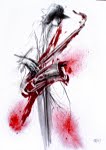
Gato Barbieri

Gato Barbieri
Autor: Andrés Casciani

miércoles, 24 de junio de 2015

Jazz en Via Veneto: Mendobrass


Roque Crescitelli & Marcos Cobo

Roque Crescitelli

Marcos Cobo

Luis Navarro - Roque Crescitelli - Mario Sosa 
Marcos Cobo - David Reyes

Via Veneto (Mendoza, Argentina ) | 29 mayo 2015

jueves, 18 de diciembre de 2014

jueves, 2 de mayo de 2013

Gato Barbieri: Fenix


Tapa del LP editado en Argentina a principios de la década del 70.
Es uno de los discos más importantes en la historia del jazz.

viernes, 15 de junio de 2012

JAZZ EN VIA VENETO CON ROQUE CRESCITELLI OLD QUARTET: RECORDANDO A LOUIS ARMSTRONG

Confitería Via Veneto | Amigorena 78 | Mendoza | Argentina
6 de julio de 2012 | 22 hs
Venta de entradas anticipadas: Jorge Lahoz (0261) 156005147


ROQUE CRESCITELLI OLD QUARTET

Roque Crescitelli: trompeta, flugelhorn | Mario Sosa: piano | Ariel Fernández: bajo fretless | Cacho Picón: batería

Recordaremos también al saxofonista PABLO KUSSELMAN, nacido un 6 de julio...

Organizan: Jazz Club Gato Barbieri & Codearte


LOUIS ARMSTRONG (SATCHMO): biografía abreviada

Louis Armstrong nació el 4 de agosto de 1901 en el seno de una familia muy pobre y en uno de los barrios marginales de Nueva Orleans. La miseria se agudizó cuando su padre, William Armstrong, los abandonó. Louis era entonces un niño y pasaría su juventud en un difícil vecindario de las afueras de la ciudad.

No existían antecedentes musicales en su familia, por lo que su interés por este arte surgió a partir de la escucha de las célebres bandas de Nueva Orleans, que desfilaban habitualmente por las avenidas de la ciudad.

Posiblemente si no hubiera disparado la pistola en el aire para celebrar Año Nuevo de 1913, nunca hubiera sido un músico profesional. El asustado niño de 12 años fue arrestado por un molesto policía y enviado al reformatorio para hombres de Nueva Orleáns para que reflexionara sobre sus actos. Afortunadamente para Louis y para el mundo musical, cayó bajo la influencia de Meter Davis, el instructor musical de la casa. David reconoció el talento en el joven niño negro. El le enseñó a cantar, también percusión y finalmente, a tocar la trompeta.

En 1914, tras su salida del reformatorio, trabajó como vendedor de carbón, repartidor de leche, estibador de barcos bananeros y otros empleos del mismo tipo. Empezó también a trabajar en los cabarets de Storyville, donde estaban concentrados todos los locales nocturnos de la ciudad; allí conoce al cornetista Joe King Oliver, quien fue su mentor y casi una figura paternal para él.

En 1919, Armstrong era tan hábil como cantante que se mudó a Saint Louis para unirse a la banda de Fate Marable. Fueron dos años excitantes para el joven ya que la banda mencionada tocaba en un crucero perteneciente a la línea de barcos de lujo "Streckfus Mississippi". El joven músico invirtió mucho de su tiempo tocando en el río y cantando para barcos de pasajeros. Tres años después, Oliver le pidió a Armstrong para que se una a la banda de jazz Creole. Fue allí donde Armstrong se enamoró y se casó con Lillian Hardin, la pianista de Oliver.

A mediados de 1920, su estrella y fama se estaban desarrolando rápidamente. Formó una banda llamada “Los Cinco Calientes” y concretó su primera grabación para el sello Okeh en 1925, incluyendo la famosa rendición de “Saint Louis Blues” con Bessie Smith. Los Cinco Calientes —luego los Siete Calientes— permanecieron juntos por tres años, pero nunca tocaron en vivo. Mientras tanto, el joven continuó tocando en otras bandas. Por 1929, Louis se estaba convirtiendo en una gran estrella del jazz ya que ahora tenía su propio grupo de para presentarse en conciertos llamado "Louis Armstrong y los Stompers". También realizó una gira con el show “Chocolates Calientes”. Pero las bandas más chicas estaban fuera de su camino y de sus proyectos

Era la década de los 30 y el swing estaba acumulando popularidad. Eso quiere decir que las bandas tenían que ser numerosas. El trompetista se mudó a Los Ángeles y organizó un grupo que se llamaba "Louis Armstrong y su nueva orquesta del club del algodón de Sebastián". Pero no estaba dispuesto a establecerse en un lugar fijo. Poco tiempo después él y Lillian se divorciaron lo que lo mantuvo deprimido y sin rumbo por bastante tiempo. Sin embargo, la gira de esa época de su banda tuvo un éxito inmenso. No solo hizo una gira por los Estados Unidos, sino que por Europa también. Cuando el volvió en 1935, contrató a Joe Glaser como su representante. Glaser se quedó con él hasta su muerte en 1971.

Al final de la Segunda Guerra Mundial, la música swing dejó de ser popular lo cual produjo que las bandas de música comenzaran a ser pequeñas de nuevo. En un concierto en el Town Hall en Nueva York, presentó a los seis nuevos integrantes de su grupo quienes finalmente lo acompañarían por el resto de su vida: los "All stars".

Luego de esos tiempo su salud le comenzó a fallar. Desde los últimos tres años de su vida permanecía por tiempos dentro y fuera del hospital, pero esto no le impidió continuar grabando y actuando hasta el 6 de junio de 1971 cuando falleció mientras dormía en su casa en Queens, Nueva York. Con su muerte, muchos críticos dijeron que el el jazz había perdido a su mejor músico.

Gato Barbieri @ B.B. King Blues Club & Grill (New York) @ Blue Note Jazz Festival: June 17


Foto: Jorge Lardone (C) 1991 | www.elcolordeljazz.com.ar
LEANDRO "GATO" BARBIERI


Born: November 28, 1932  | Rosario (Argentina)


Mystical yet fiery, passionately romantic yet supremely cool…You hear those first few notes from that instantly recognizable tenor and know you’re in the unique musical world of Gato Barbieri.


Beginning professionally as a teenager playing alto sax in Buenos Aires clubs, Barbieri’s enduring career has covered virtually the entire jazz landscape, from free jazz (with trumpeter Don Cherry in the mid-60s) and avante garde to film scoring and his ultimate embrace of Latin music throughout the 70s and 80s.


He began playing tenor with his own band in the late 50s and moved to Rome with his Italian born first wife Michelle in 1962, where he began collaborating with Cherry. The two recorded two albums for Blue Note, “Complete Communion.” and “Symphony for Improvisers,” which are considered classics of free group improvisations. Barbieri launched his career as a leader with the Latin flavored “The Third World,” in 1969, and later parlayed his Grammy winning “Last Tango In Paris” success into a career as a film composer, scoring a dozen international films over the years in Europe, South America and the United States.


From 1976 through 1979, Barbieri released four popular albums on A&M Records, the label owned by trumpet great Herb Alpert. “The Shadow of the Cat,” is a reunion of sorts for the two, with Alpert playing trumpet and trumpet solos on three songs.


Barbieri officially took up the clarinet at age 12 when he heard Charlie Parker’s “Now’s The Time,” and even as he continued private music lessons in Buenos Aires, he was playing his first professional gigs with Lalo Schifrin’s orchestra. “During that time, Juan Peron was in power”, he recalls. “We weren’t allowed to play all jazz; we had to include some traditional music, too. So we played tango and other things like carnavalito.” In Buenos Aires, Barbieri also had the opportunity to perform with visiting musicians
like Cuban mambo king Perez Prado, Coleman Hawkins, Herbie Mann, Dizzy Gillespie, and João Gilberto.


Barbieri credits his learning of musical discipline to his years working with Don Cherry while living in Europe. While collaborating with Cherry in the mid ‘60’s, he also recorded with American expatriate Steve Lacy and South African pianist Abdullah Ibrahim. Other associations during Barbieri’s free jazz days included time with Charlie Haden, Carla Bley and the Jazz Composer’s Orchestra, as well as dates with Stanley Clarke, Airto Moreira, Chico O’Farrell, and Lonnie Liston Smith.


He had recorded a handful of albums on the Flying Dutchman label in the early 70s and then signed with Impulse where he recorded his classic Chapter Series “Latin America ,” “Hasta Siempre,” “ Viva Emiliano Zapata,” and “Alive in New York .” While at Impulse, “Last Tango”hit, and by the mid-70s, his coarse, wailing tone began to mellow with ballads like “What A Difference A Day Makes” (known to Barbieri as the vintage bolero “Cuando Vuelva a tu Lado”) and Carlos Santana’s “Europa.” Barbieri’s A&M recordings of the late ‘70’s, featured this softer jazz approach, but early 80s dates like the live “Gato…Para Los Amigos,” had a more intense, rock influenced South American sound.


After many years of limited musical activity due to the passing of his first wife Michelle (also his closest musical confidant and manager) and his own triple bypass surgery six weeks later, Barbieri returned stronger than ever with the 1997 Columbia offering “Que Pasa,” the fourth highest selling Contemporary Jazz album of the year.


There have been several recent highlights in Gato’s life: In July of 2003, Long Island University and WLIU combined to give Gato a Lifetime Achievement Award. In September of the same year, Boston Symphony Orchestra’s Tanglewood Jazz Festival headlined Gato Barbieri at the Ozawa Concert Hall. The performance was broadcast live by Boston’s WBGH and New York ’s WBGO; it was the beginning of the fledgling NPR station network as the concert was simulcast over eight stations from New England to Pennsylvania to Chicago .


The 2004 Puerto Rican Heineken Jazz Festival featured Gato as the 2004 Honoree.


Late in 2004, Gato was honored by his homeland of Argentina when the Argentine Ambassador presented him with a Lifetime Achievement Award at a special function at the Argentine Consulate in New York City.


Also in 2004, Universal Music released four new compilation CD’s in their world renown “20th Century Masters” series: Sarah Vaughan, Charlie Parker, Carmen McRae, and Gato Barbieri. This association with other jazz icons only serves to once again confirm Barbieri’s legendary status both within the music business community and to the entire world.


In 2009 Barbieri released “In Search of the Mystery.”


Gato's new album “Encounter” was released in late 2010, featuring Gato Barbieri, Carlos Franzetti, David Finck and Nestor Astorita. (Melopea Records, Buenos Aires, Argentina)


Source: James Nadal
http://www.allaboutjazz.com/php/calendar/event_detail.php?id=460471#.T9ZpVoDsD2Q.facebook

domingo, 18 de diciembre de 2011

Testimonio de una jam session inolvidable...

roque crescitelli
pedro "peter" caliva
leo cabaña
roque crescitelli | héctor & leo cabaña
roque crescitelli
 
héctor "pirincho" cabaña


mario tortosa
galería de arte sextoMundo
Testimonio fotográfico de una jam session inolvodable del Jazz Club Gato Barbieri con la participación de músicos de San Rafael y Mendoza, en la Galería de Arte sextoMundo (San Rafael), el 27 de julio de 2006.

Foto tomadas con una cámara digital familiar de escasas prestaciones y calidad por Jorge Lardone.


lunes, 24 de octubre de 2011

ROQUE CRESCITELLI, EL TROMPETISTA DE MENDOZA (ARGENTINA)

ROQUE CRESCITELLI PRESENTA SU PRIMER CD:
"CON UNA CANCIÓN EN MI CORAZÓN"


TEXTO EN ESPAÑOL / ENGLISH TEXT

La presentación será con los siguientes músicos:
Roque Crescitelli Cuarteto: Roque Crescitelli: trompeta, flugerhon | Mario Sosa: piano | Cacho Picón: batería | Ariel Fernández: bajo fretles

Invitados:
Albertina Crescitelli: piano | Mariano Moreno: piano | Juan Pablo Moltisanti: piano | Nene Campos: saxo tenor | Bebe Pochettino: guitarra | Gustavo Meli: batería | Lilen Graziosi: canto

Lugar: TEATRO UNIVERSIDAD - Lavalle 77, Mendoza
Auspicia: SECRETARÍA DE EXTENSIÓN UNIVERSITARIA DE LA UNIVERSIDAD NACIONAL DE CUYO

Roque Crescitelli | Trompeta, flugelhorn.

Nacido en Maipú (Mendoza) está considerado en la actualidad el mejor músico de jazz de esta parte del país. En su juventud realizó sus primeros estudios musicales en la Escuela Superior de Música dependiente de la Universidad Nacional de Cuyo.
Su actividad profesional comenzó en Buenos Aires en la décadà del 60` mientras realizaba estudios universitarios en el área de la Óptica y Contactología.

Fue integrante de innumerables orquestas y grupos tanto de jazz como de otros tipos de música. Entre los músicos que tocaron con él se puede mencionar a algunos de los más destacados músicos de la escena jazzística, entre ellos Bernardo Baraj (saxos), Rubén Barbieri (trompeta), Gustavo Bergalli (trompeta), Juan Barrueco (guitarra), Junio Césari (batería). Entre las orquestas podemos mencionar la del pianista Lito Valle. Paralelamente con su actuación profesional efectuó estudios privados de música con distintos profesores.

Su carrera en Mendoza lo ha llevado a tocar, además de todo tipo de géneros musicales, con los más importantes músicos de la provincia, entre ellos: Sergio Muriel (piano), Pedro Caliva (guitarra), Bernardo Castillo (saxo), Rubén Menéndez (saxo alto, cubano), Chiquito Llera (batería), Minti Gutiérrez del Barrio (vibráfono), Mono Iturgay (batería), los hermanos Giunta (piano), Eduardo Gutiérrez del Barrio (piano), Mario Matar (guitarra), Facundo Guevara (percusión), Horacio Gómez (piano),Pablo Kusselman (saxos), Jordi Clua (contrabajo, español), y un largo etcétera que incluye a cuanto buen músico de jazz ha pasado por la provincia y sus alrededores.

Entre los grupos que ha integrado podemos mencionar los siguientes: “Jazz en Quinteto”, “Swing tempo”, Xwingo Combo Latino”, “Jazz Time”, “Black Swing”, “De mil amores”, “Fotojazzeando” y "Sparkling Big Band".
Asimismo ha intervenido en numerosas actuaciones como artista invitado, tanto en el campo del jazz como fuera de él: con el cuarteto “Mr. Jazz”, el grupo de rock “Enanitos Verdes”, la Orquesta Sinfónica de Mendoza, por ejemplo.

Ha participado de numerosos Festivales de jazz tanto en la provincia como fuera de ella y también en Chile.
Fue convocado en numerosas oportunidades por el Festival Internacional Fotojazzeando, donde tuvo oportunidad de tocar con músicos extranjeros de jerarquía como la cantante estadounidense Gail Wynters, el contrabajista chileno Luis Basaure y la pianista brasileña Ziara Brant de Carvalho, entre otros.


ENGLISH (Google translation)

The presentation will be with the following musicians:

Roque Crescitelli Quartet:  Roque Crescitelli: trumpet, flugerhon. | Mario Sosa: piano |
Cacho Picon: drums | Ariel Fernández: electric bass

Guests:
Albertina Crescitelli: piano | Mariano Moreno: piano | Juan Pablo Moltisanti: piano | Nene Campos: tenor sax | Bebe Pochettino: guitar | Gustavo Meli: batería | Lilen Graziosi: voice

Location: UNIVERSITY THEATRE - 77 Lavalle, Mendoza
Sponsors: UNIVERSITY EXTENSION DEPARTMENT OF THE UNIVERSITY OF CUYO

Roque Crescitelli | Trumpet, flugelhorn.

Born in Maipú (Mendoza) is currently considered the best jazz musician of this part of the country. In his youth he made his first musical studies at the music school dependent of the Universidad Nacional de Cuyo.
His professional activity began in Buenos Aires in the early 60's while doing undergraduate studies in the area of Optics and Contact Lenses.

He was a member of numerous orchestras and jazz groups both as other types of music. Among the musicians who played with him we can mention some of the most outstanding musicians of the jazz scene, including Bernardo Baraj (sax), Ruben Barbieri (trumpet), Gustavo Bergalli (trumpet), Juan Barrueco (guitar), Junior Cesari (drums). Among the orchestras we can mention the pianist Lito Valle. Parallel to his private studies conducted performance of music with different teachers.

Mendoza's career has taken him to play, plus all sorts of musical genres, with the most important musicians of the province, including: Sergio Muriel (piano), Peter Caliva (guitar), Bernardo Castillo (sax), Rubén Menéndez (alto sax, Cuban), Chiquito Llera (drums), Chiquito Gutiérrez del Barrio (vibraphone), Mono Iturgay (drums), Giunta Brothers (piano), Eduardo Gutiérrez del Barrio (piano), Mario Matar (guitar), Facundo Guevara (percussion), Horacio Gomez (piano), Pablo Kusselman (sax), Jordi Clua (bass, Spanish), and a long list that includes jazz musician as well have gone through the province and its surroundings.

Among the groups we can mention that it has integrated the following: "Jazz Quintet", "Swing tempo", "Xwingo Combo Latino "," Jazz Time "," Black Swing, " " De mil amores ",  " Fotojazzeando " & "Sparkling Big Band".

He has also participated in numerous performances as guest artist, both in the field of jazz as outside it with the quartet "Mr. Jazz ", the rock group" Enanitos Verdes ", the Symphony Orchestra of Mendoza, for example.
He has participated in numerous jazz festivals both in the province and beyond and also in Chile.

He was summoned on numerous occasions by Fotojazzeando International Festival, where he had a chance to play with foreign musicians of like singer Gail Wynters (USA), bassist Luis Basaure (Chile) and Brazilian pianist Ziara Brant de Carvalho, among others.